Abstract
This project asked how premodern Islamic societies were formed through movement across cultural boundaries. Focusing on the people who translated, transferred, and transformed knowledge, practices, institutions, and forms of authority, the group developed cultural brokerage as a historical framework for explaining change across the Islamic world from the seventh to the fifteenth century.
Publication outcome · Edinburgh University Press · 2026
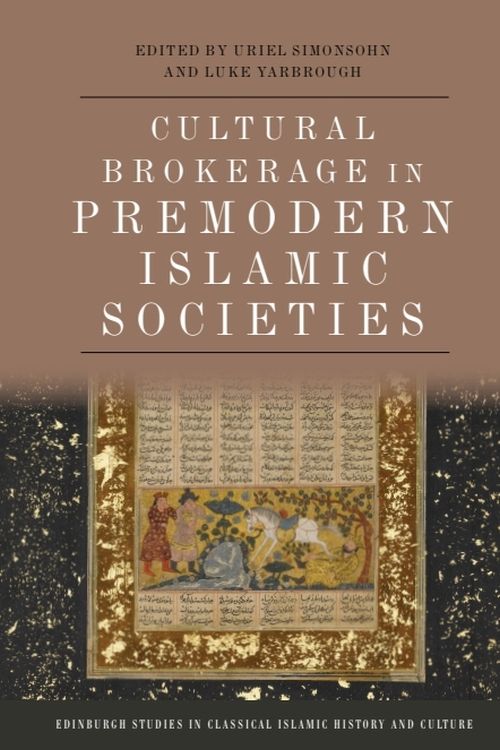
Cultural Brokerage in Premodern Islamic Societies
Edited by Uriel Simonsohn and Luke Yarbrough, this volume asks how the cultures called “Islamic” were formed in relation to neighboring cultural worlds. It focuses on cultural brokers—people who mediated between different spheres by transferring and translating ideas, practices, institutions, and forms of knowledge.
Developing a historically grounded theory of cultural brokerage, the collection brings together case studies spanning the seventh to the fifteenth century, from China and Central Asia to Byzantium, Iran, the Middle East, North Africa, and the Iberian Peninsula.
Research Group
Cultural Brokerage in Pre-Modern Islam was an international research group at the Israel Institute for Advanced Studies in Jerusalem, convened from 1 September 2020 to 30 June 2021. It was organized by Prof. Uriel Simonsohn (University of Haifa) and Prof. Luke Yarbrough (UCLA).
Rethinking the Formation of Islamic Civilization
Islamic civilization developed through long processes of encounter among multiple cultural, religious, linguistic, and social traditions. Rather than treating it as a uniform culture created in a single moment or place, the project examined how diverse practices, institutions, texts, and forms of knowledge gradually acquired Islamic meanings in different settings.
This approach directs attention to exchange, translation, borrowing, adaptation, and hybridity—and especially to the people who made such movement possible.
What Is a Cultural Broker?
Cultural brokers are individuals who mediate between social and cultural worlds. They transfer, translate, embody, and transform forms of capital such as religious authority, scholarly knowledge, kinship connections, legal expertise, languages, administrative skills, and commercial networks.
The group investigated several interrelated questions:
- Who served as a broker—converts, courtiers, communal leaders, women, merchants, missionaries, scholars, captives, or holy figures?
- What circumstances enabled brokerage—translation, bureaucracy, trade, travel, enslavement, intellectual encounter, or technological need?
- What resulted from it—new texts, knowledge, institutions, poetic forms, technologies, architecture, or patterns of urban life?
Participants
- Uriel Simonsohn, University of Haifa
- Luke Yarbrough, UCLA
- Michal Biran, Hebrew University of Jerusalem
- Eugenio Garosi, LMU Munich / University of Basel
- Jessica Goldberg, UCLA
- Louise Marlow, Wellesley College
- Maria Mavroudi, University of California, Berkeley
- Gregor Schwarb, SOAS University of London
Wider Research Context
The project informs Prof. Simonsohn’s continuing research on converts as cultural agents in the early Islamic world, including the networks, knowledge, and social positions that enabled them to mediate across religious and cultural boundaries.
Explore the related project on Kinship and Community in Early Islam or return to the publications page.